Sunday, May 15, 2011

GAUGE presents 2010 AIGA LA Fellow, John Coy (May 12, 2011)

On Thursday, I attended the GAUGE presents 2010 AIGA LA Fellow, John Coy event with my classmates from ART 220. This event’s attendance was mandatory per our Professor Jimmy Moss. There was a little confusion at first amongst my classmates at what time the event actually started. On all the posters inside the Fine Art Building, it read the start time as 7:00PM but on the Facebook GAUGE page, it said 7:30PM. But due to technical difficulties, the presentation didn’t start until 8:00PM. 

Due to the technical difficulties, John Coy started off hearing what kind of questions his audience asked. He then proceeded to talk about design. He mentions that a designer needs to develop their own uniqueness and to know one’s own unique program. John also mentions that each one of us is unique and if we can tune into our own uniqueness, then that alone will open up new paths for us. If you have your own unique style, stick with it and get your work out there. Once you get your work out, others will see it and people will gravitate to you. They’ll like what they see and come to you for a project. Also, if you have a great relationship with your client, your client will recommend your work to others. Be sure to care about your work and what you do, and show it. It will come back around in a good way.

When the slide-show started working correctly, John Coy was able to present to us some of his highly acclaimed work. He has had a lot of great career opportunities, like working with University of California, Los Angeles (UCLA), The Getty Center in Los Angeles, and the Museum of Contemporary Art, Los Angeles (MOCA). He’s also done a lot of work for the high end mall, South Coast Plaza in Costa Mesa, CA.

After the slide-show was completed, John started another question and answer session. Being a designer means using a computer as a tool. John goes to say that the computer is a wonderful tool but it can drive you crazy and separate you from the Earth. So it’s good to once in a while meditate because it will get yourself into a positive place. It’s also good to reconnect with the Earth by getting some sun or get your feet into the sand.

I learned some valuable information from John Coy. I learned that we can’t lose our sense of self. We need to show our skills and who we are as a designer. We need to incorporate our unique skills into our work and add our own personal work to our portfolio. Also, when working on a project try not to do something that you don’t want to do because John was asked the question, “Have you worked on a project that you didn’t want to do?” And his answer was, “Yes. But it doesn’t lead you to great things.” With John saying that, it really meant something to me. In pursuing your career, you want to be in a profession that you love and have a passion for. You don’t want to have a job or pursue a career that you’re going to hate doing every day. So in working on projects that you’ll enjoy, it can lead you to bigger and better things as people start to take notice of your work and uniqueness. Also, you need to love everything that you create and do. You should never dislike anything you do. Lastly, it’s important to know the right questions to ask the client. With good input and collaboration between the designer and the client, it can turn into a great experience and can potentially become an ongoing relationship with the client on future projects.

The Design Process – Stage 6: Communication

Communication is a very essential tool for a designer to have. A designer must be able to clearly and effectively communicate their idea to their audience, which is the client, corporate offices, production staff, and fellow designers. In this chapter of The Design Process, Aspelund goes into great detail of how to present your ideas to your audience. Always be sure to have a plan. When getting ready to have a meeting with your client to present your idea/work, be sure to have the correct type of preparation for whichever venue the meeting will be at, whether it’s at a restaurant, conference room, the clients office, or a hotel room. It’s up to the designer to be fully prepared and have all the correct equipment or handouts as necessary. Even if a client says their office will have the proper equipment needed for the presentation, it’s always a good idea to bring your own backup equipment just in case there is a compatibility issue with the client’s equipment. 

Language is also very important. Your presentation should show three types of modes for language, visual, written, and spoken. All three modes should be clear and consistent. A visual does not always give out all the information, so use or writing and verbal description will greatly get across your meaning. Also be very knowledgeable about your idea. Know the ins and outs of this project and if there are flaws, be sure to mention them, because you can always get feedback from the client for a solution but don’t spend too much time on the flaws and don’t hide anything either. 

A presentation should have a beginning, middle, and end. Make sure that your presentation is captivating and will really grab the audience’s attention. You want to be able to convince them about your idea and show how excited you are about the project. Don’t be too overly excited though. You want to make sure that your presentation steers your audience in the direction “where everyone is ready and willing to believe in the viability of your design” (Aspelund 164).
In the perspectives section, Mark Zeff, a designer and architect, talks briefly about his experiences as a designer and how important communication is. He mentions that at his design firm, after the first meeting, he creates a design brief, which is another name for a creative brief. He goes to say that in his brief it says something like, “’It’s my understanding in this first encounter that this is what you want, this is what you don’t want, this is how big it is, this is how much it is, and is this true?’ ‘Have we forgotten that?’ and ‘I have been reading your letter, and there were some other things you brought up,’ and so on” (Aspelund 165). I also found it interesting how he has a website where his clients can log into, to check the status of their project. Having that type of website set up is a good means for communication. Also, if there is a problem, Mark wants everyone to hear the solution from him. So he doesn’t only include the specific staff working on that specific project, but includes his entire company on every project so that they can use what they have learned in all these meetings and apply them to the projects they are currently working on and on future projects. I believe this helps the company grow and improve each time a new project arrives. Mark also mentions that drawing by hand is a very important skill as a designer because it allows the designer to put whatever idea they have in their head onto paper within 10 seconds. I also learned that it is good to be a brave designer. A designer should feel intimidated. They should feel brave and be able to speak up if they have a suggestion that they feel will really work for the client. They should just sit idly by and only listen to what the client wants, but should be able to speak up and not be afraid to try something out if they feel it will really work in the client’s best interest.


Aspelund, Karl. The Design Process. Second Edition. New York: Fairchild Books, 2010. 164, 165. Print.

Friday, May 13, 2011

"But it has got to go!" (5/11/11)

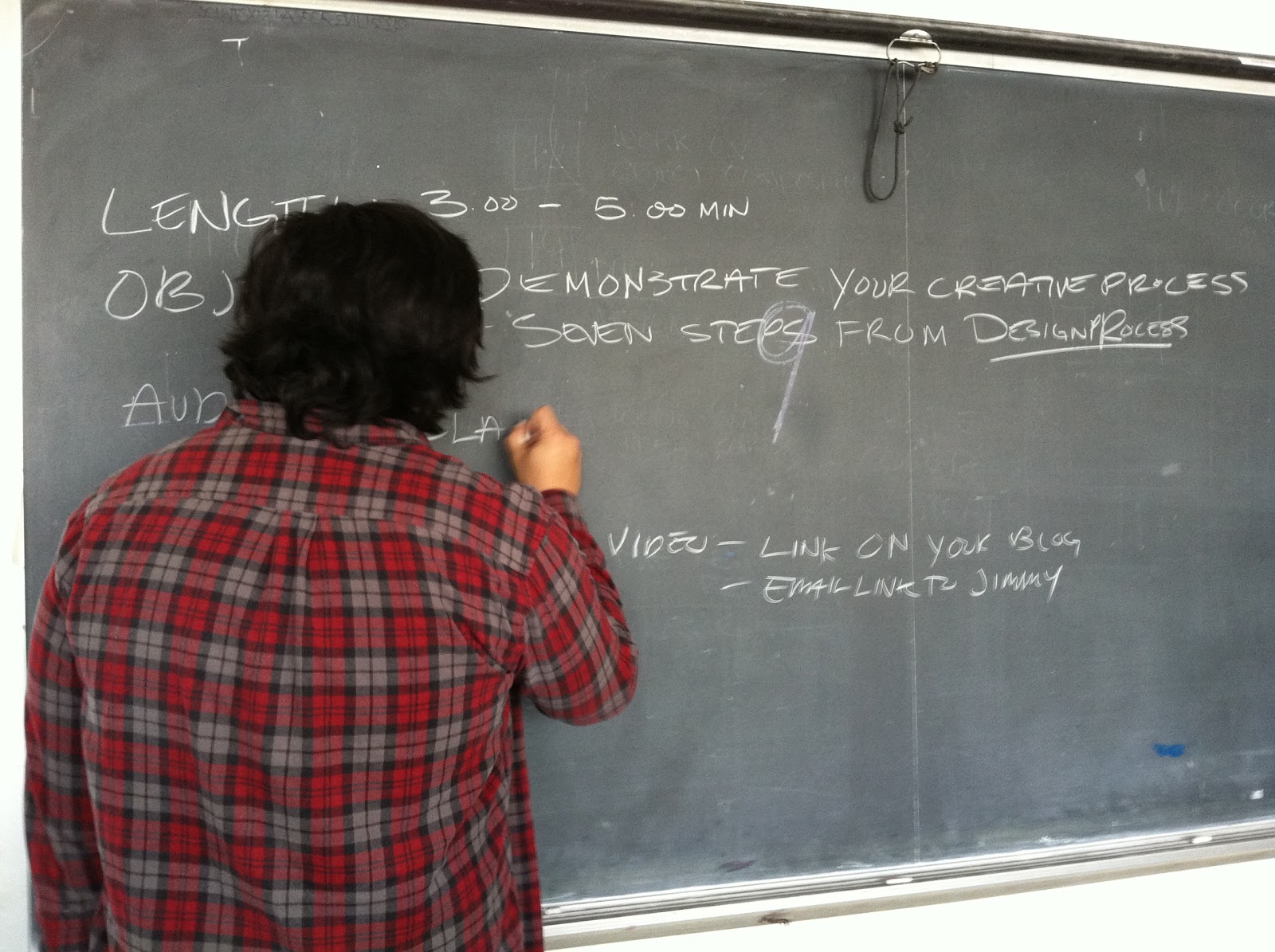
Wednesday’s class was cancelled due to Professor Moss being out sick. The Art department’s assistant, I believe her name is Veronica, came to our class to tell us the news. She told us that Jimmy wanted us to discuss our final project amongst ourselves before leaving class and to create a sign in sheet and return it to her office. We stayed in class for about twenty minutes and discussed our final project which is to individually film a video that will demonstrate our own creative process. We decided that our audience is our class peers and professor, and the deliverable is our video, which should have a length of at least 3 minutes and is not to exceed 5 minutes. Our video will be posted on our blog and the URL emailed to our professor Jimmy Moss. The posted video and email are due before 8:00AM on June 6th, the day of our final.


After we finished discussing our final project, Astrid turned in our creative briefs and the sign in sheet to Veronica’s office. As we all left class, it felt as though no one really knew where to go and what to do with the extra free time. Since my next class didn’t start until 10:50AM, I walked around with Astrid, Jackie, and Sandy trying to decide what we could do. Since my stomach was grumbling, I offered to drive to IHOP for breakfast and we had a delicious meal. We all had a great time and really got a chance to get to know each other better. We even had a funny and unforgettable bug experience at IHOP, which is why the title of this blog may not make sense to anyone else who wasn’t there, unless we told you our story yesterday at the John Coy presentation. :) When we got back to campus, we still had additional time to kill and decided to play card games. The best game played was Slap Jack. We may have gotten a little rowdy as we played but we didn’t care since we were having a good time. Once it was time to go to my next class, I was little sad because of how much fun I was having. But off I went class like the good student I am. I’m actually proud of myself because this is probably the first quarter of school where I have not missed a single day of class for all of my classes. I may have been late once or twice for a class, but other than that, I have had perfect attendance. I hope to keep it up with only the last three weeks of the quarter remaining.


Tuesday, May 10, 2011

Creative Briefs (5/09/11)

Yesterday in class, we mainly spent our time going over creative briefs. Jimmy read over some of the creative briefs he was able to collect over time from real clients and design firms. He said these creative briefs are like gold, because they’re proprietary information. Creative briefs are almost never given out for whatever reasons from the designer or design firm. This may be because they are trade secrets from the design firm. They don’t want to give away how they do their work. Our previous homework was to create two creative briefs. This was my first time writing a creative brief so I did feel lost when I started writing. So what exactly is a creative brief? Jimmy said that a creative brief is what the designer presents to the client. It is a written document that basically says, “This is what I understand the project to be…” It is what is used to begin a project and it includes what will be going on in the project for example, project size, budget, resources, schedule, deadlines, and what is delivered at the end.

The first creative brief Jimmy read was a rather long brief, about three pages long but it was very detailed and very well wrote and thought out. This brief alone shows how much the designer is willing to invest time and hard work into the project. This brief also had very good use of adjectives, which is also a good tool for designers. To be able to know and use a lot of adjectives will really be beneficial to a designer. Adjectives are very useful when communicating ideas. This brief had specific and important sections addressed: Assignment, Target Audience & Demographics, Brand Positioning, Tone & Character, Desired Outcome, Competitors, Differentiators, and Integrated Marking Strategy. The creative brief was very detailed and to the point and the project turned out to be for a website. When you think of a website, you don’t necessarily think about how much time goes into the website. But hearing all this, it sounds like the outcome is going to be a very impressive and creative website.

As I was writing my briefs, I tried to add the information Jimmy told us to, which is to ask the questions: who, what where, when why, how, how much, how long. The budget part was the only part we didn’t need to add at this time. I also tried to make it as brief as possible, yet to the point. After hearing the creative briefs Jimmy brought to class, I can say that I may have had the correct sections included, but could have expanded a littler more to help clarify the information I was presenting. By just hearing examples of creative briefs in class, it gave me a better idea on how to write a good creative brief. I now know that the overview should be about three sentences long, very straight forward and to the point. I also need to be more detailed, have good use of adjectives to express my idea more clearly, to really show the client how invested I am in creating and working diligently on the project. 


Saturday, May 7, 2011

The Design Process – Stage 5: Definition/Modeling

In this chapter, Aspelund talks about the levels of a design’s needs that go with the creation of the model. These levels are functionality, reliability, usability, proficiency, and creativity. When a design is created, it needs to have these five levels in order for the design to be successful. After already making concept maps and sketches of the design, it is time to create a model that can physically be touched. This not only helps the client to visually see what the design’s potential has, it also gives the designer the chance to think of what materials could be used for the final product. It’s always a good idea to try and use environmentally safe materials. In addition, in the modeling process, when problems arise, the designer can come up with possible solutions along the way. When building a model, there are certain things to a designer must watch out for. A model is not the real thing but the model should convey functionality in order for their audience to understand it. Aspelund goes to say, “A model is a model, regardless of how much is said. It requires a mental journey on behalf of the audience, and you, the designer, must help your audience make that trip” (Aspelund 130). Time management is also a big factor when creating a model. A designer must make sure to manage time wisely so that there is enough time to build the model and prepare for the presentation of the model.

I found this chapter to be very important in the design process. Modeling is an important step because it gives your audience the chance to really understand what the outcome of the project will be. If you are unable to clearly express your concept to your clients, they are not going to be happy and may even go elsewhere for business. In reading the perspective section on Ian Cunningham, he mentions that he learned that his previous career as a consultant, it demanded that he sketch more. He even goes to say, “ I think you still have to draw a lot as a designer to get good at thinking through problems, to think about three-dimensional solutions in a two-dimensional [medium]” (Aspelund 136). He also goes to say that designers need to have clear communication. These are also the two things that that professor Jimmy Moss always stresses on. If we are passionate about design, we need to constantly exercise our creative skills and be able to clearly and effectively communicate them.

Aspelund, Karl. The Design Process. Second Edition. New York: Fairchild Books, 2010. 130, 136. Print.


Thursday, May 5, 2011

Professional Presentation (5/4/11)

Yesterday’s class was about professionally presenting one game idea. It could have been from the nine initial ideas from our previous homework assignment or to create a brand new idea. For my assignment, I decided to create a new idea. I wasn’t satisfied with my nine original ideas so I sat down and thought about a new game. I wanted to create a digital game, something that could stand a chance in today’s world. So I decided to create a DVD game along with an application game for the smart phones. I think that this time around, a lot of people did come up with better ideas than what they presented on Monday’s class. And a lot of the work did look nicer and cleaner. They may not have reached Jimmy’s expectations on clean presentations, but I saw it as a big improvement from what was presented on Monday’s class because that day, many people only did sketches in pencil and didn’t use colors. This time around, people took the time to draw cleaner and a lot of people even used printed work.

When it came time to go over everyone’s work, it was dreadful. Jimmy had turned over everyone’s presentation boards and as he did that he said, “don’t hate me.” On the backsides of the presentation boards, there were the store labels left on, or there were names written on the back. No one had a presentable backside except for one student, Lorraine. She had made her own label and placed it on the bottom right corner on the back of her board. It was a typed up label with her name, email, and class information. Even the front side of her board was very nice and very presentable, all flat and no corners folding up. It was a good example of what we should all be doing for all our assignments, which is to make it look professional and presentable. Jimmy’s point was that if we were presenting/pitching our ideas to a client, our client would not find it amusing that there was still a sticker left on the backside of our work. The client would expect the best and cleanest presentation possible. They may be even looking for something flawless. Some students were chosen to present their boards. Jimmy wanted us to critique our classmates based on their body language. It’s interesting to learn about people’s body language because a lot of people usually lean towards shy or confident. I think there’s always going to be that factor of nervousness because you’re going in front of either a small or large crowd and all the attention is on you. I am always nervous when it’s time for me to present. I sometimes present strongly but most times I fumble and use “oatmeal” words as Andrew put it. Using words like, “umm” after almost each sentence. But what I try to be is confident about the work I did. It may be the crappiest work I’ve done but I still did it and should stand up for it. As I learned in class, it’s a good idea to always back up your work and be confident about it, to stand behind your work, either literally for figuratively. Don’t be too overly confident, but be confident enough in your work. Because if you’re not confident about it, then the client isn’t going to be confident about it and you may just lose that client for possible future projects.

What I’m learning about this class is that Jimmy doesn’t tell us to do a lot of things because he wants us to think about it first. For example, the way we should label our work. I also think this is why I think Jimmy likes to be vague about the way he describes our assignments. He wants us to in a sense, interpret it in our own way so that we have that flexibility to think creatively about the problem and find our own solution to the problem.  I believe that yesterday’s class was a real test to see just how far we’d go to make a professional and presentable pitch.


A Designer's Passion (5/2/11)

On Monday’s class, May 2nd, Jimmy started off the class by talking about the AIGA Student Portfolio Day, an event that happened on Saturday, April 30th. He talked about how students brought in their portfolios but all they had included in their portfolios were their work from class projects/assignments. The students didn’t bring in any personal work of their own. Designers should possess passion to create. In order to do that, a designer needs to constantly practice design everyday. Incorporate design into your everyday life. Don’t just let it be used on class projects only. Open up to practicing everyday and generating new ideas. Get your creative mind pumping. A designer needs to take the initiative, have self-motivation and personal passion to make a career of design in the outside world. Because these portfolios didn’t include any personal work, there was no sense of the artist or individual. It just only proved that the student could do the assignment correctly. This is not the first time I have heard about adding personal projects to your portfolio. When I went to see Seth Johnson’s presentation, one of his topics was “Make your own work.” He said, “Don’t be afraid to put your own work in your portfolio. It’s a conversation starter at an interview.” Also, my professor Robert Martin also said this in his classroom as well. Having your own personal work grabs more attention when you are at an interview for a job. It is a conversation starter. The interviewer may ask you questions about your work and they get a feel for what kind of style you have. They may really like your work and can see that your style will really fit in with their company. Of course it can go the other way around, where they don’t particularly like your style and may not offer you the job but that shouldn’t discourage you either. Professor Robert Martin just says something like that’s a good thing because it gives you the opportunity to find work at a better company. Somewhere that will really appreciate your work and hopefully help you grow in their company.

Jimmy also mentioned “Breath of Application”. It is the way a designer expresses their ideas through motion design, print, or interaction with computer programs. It is the designer’s technical skills as well. When a designer is at an interview, the interviewer is going to automatically assume that the designer is a master at using Adobe Creative Suite. And it is up to the designer to practice, refine, and master their skills with Adobe Creative Suite in order to land the position. Practice and learn new technical skills everyday. Don’t just settle with what you already know. Designers need to have a wide range of skills. They need to be articulate, critical thinkers, problem solvers, and be able to communicate clearly, effectively, and appropriately in order to be successful. It all comes down to what does the designer brings to the table because without sufficient skills, a designer cannot be successful.  So keep practicing, keep learning, and keep designing everyday. Even if it is just sketching for 10 minutes a day as Karl Aspelund advised designers to do in his book, The Design Process.

Also in class, we went over our homework assignment, which was to come up with nine new games. Some were good ideas and some were bad ideas. A lot of people kept to the classical board game theme of using a dice to move around a board, which is a game of chance. It’s what I grew up with and what I thought of too when making my games. But Jimmy brought up a good point where kids these days don’t play the normal board games anymore. They’re growing up in a digital world where they’re playing with iPod Touches and video games. Even my seven-year-old niece has an iPod Touch of her own. So when I initially thought of creating games, I didn’t have that state of mind to think of video games or application phone games. I still had the idea of games that I played during my childhood. But as a designer, I should be thinking a little differently. Think about the here and now and what game can really be successful in today’s digital world.